The Beauty of Holy Week & the Triduum
Hello again, St. Columba School and Parish Family. By the time you’re reading this it will be (or will very soon be) Palm Sunday, the beginning of what the Church calls “Holy Week.” Holy Week is the most sacred part of our church calendar -- our liturgical year. This one week encapsulates every aspect of our faith: the institution of the Eucharist, the passion and death of Jesus, and his glorious resurrection.
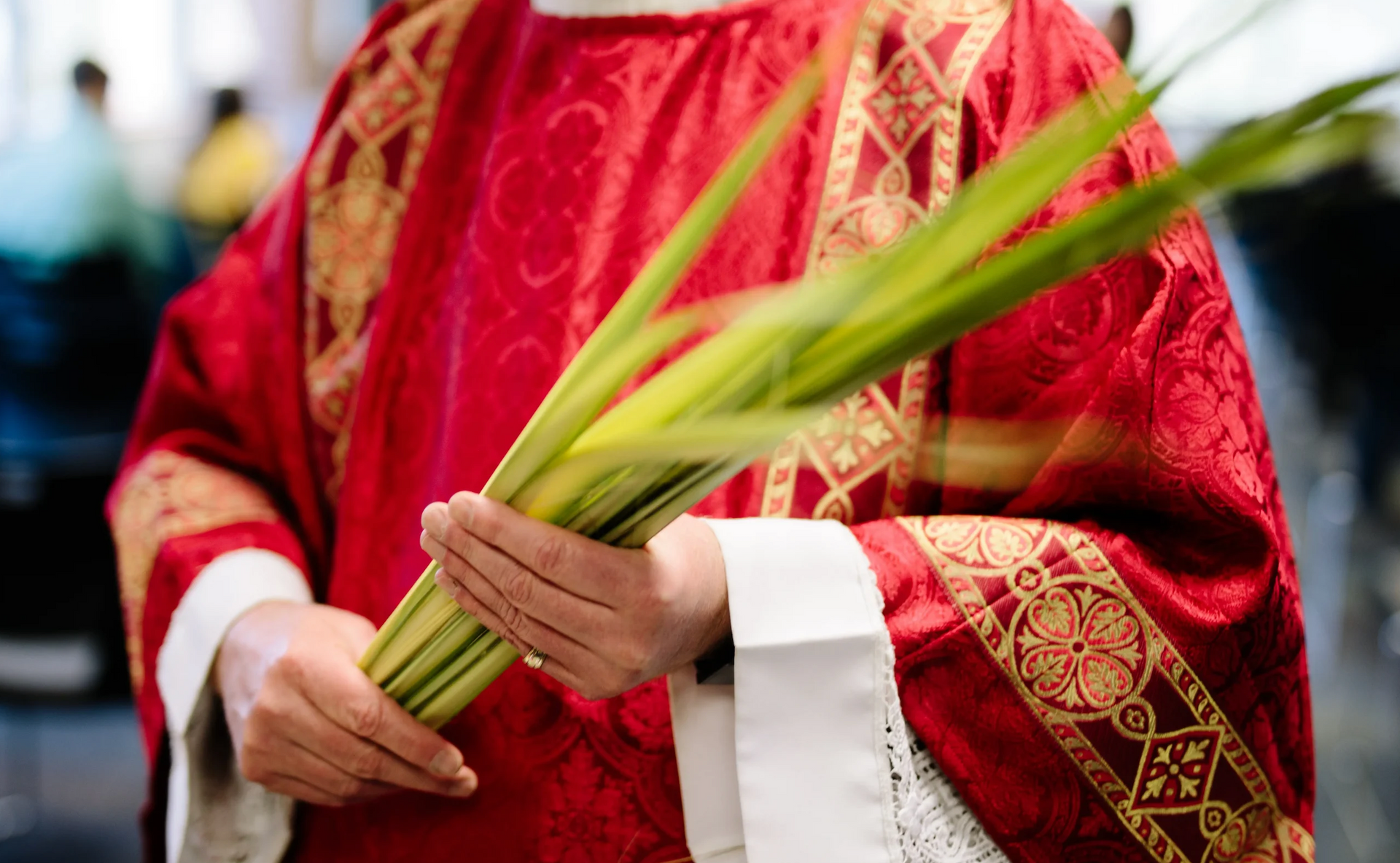
Palm Sunday is actually two Sundays in one. First, we listen to the passage in the Gospel of Matthew (Mt. 21:1-11) where Jesus rides a donkey triumphantly into Jerusalem and is celebrated as a great prophet. People lay their cloaks on the road in front of him, others cut palm branches and lay them ahead of him, and they shout “Hosanna! Blessed is he who comes in the name of the Lord!” Then we process from the gym into the church, waving palm branches and singing “Hosanna! Hosanna! Hosanna in the highest!” as a commemoration of this great event. (As an aside: we repeat that refrain about 7,526 times on our walk from the gym to the church.)
Palm Sunday continues once we get to the church, the singing stops and the mood immediately changes; we go from triumphant to somber, from joyful to sorrowful. We hear the first reading from the prophet Isaiah (Is. 50:4-7): “I gave my back to those who beat me, my cheeks to those who plucked my beard; my face I did not shield from buffets and spitting.” We sing the responsorial psalm (Ps. 22): “My God, my God, why have you abandoned me?” We hear the second reading from St. Paul’s letter to the Christians in Philippi (Phil. 2:6-11): “He humbled himself, becoming obedient to the point of death, even death on a cross.” Finally, we reenact, through spoken word, Jesus’ passion and death according to the Gospel of Matthew (Mt. 26:14—27:66). Judas takes the 30 pieces of silver, the disciples meet for the Passover meal, they go out to the Mount of Olives to pray, and there Jesus is arrested and the disciples -- his closest friends -- all flee. Peter denies knowing him, he is questioned by Pilate, and then he hears the chants of the crowd: “Let him be crucified! Crucify him!” -- the same crowd who, just a week prior, were shouting “Hosanna! Blessed is he who comes in the name of the Lord!” Then Jesus is led away to Golgotha, nailed to a cross, and dies. At the point of his death, Jesus cries out "Eli, Eli, lema sabachthani?" which means, "My God, my God, why have you forsaken me?" …The Gospel of the Lord.
What mental and emotional whiplash! In 35 minutes we've gone all the way from “Hosanna in the highest!” through “Crucify him!” to “My God, why have you forsaken me?” And so it probably felt for Jesus and the apostles as well. How great it must have felt for them to see Jesus -- their friend -- riding into Jerusalem to shouts of joy, and yet a week later suddenly the crowd has completely turned on him. It was a lot to take in for them and, indeed, they were still struggling to truly understand even after Jesus had risen from the dead (and with that in mind, let’s give ourselves some slack if we’re still struggling to “get it.”). Thankfully for us, the Church in her wisdom gives us another opportunity to take all of this a little more slowly and contemplate more deeply on all that has happened. The Sacred Paschal Triduum (“the three days”) is this opportunity.
Holy Thursday, Good Friday, and the Easter Vigil comprise what is called “The Pascal Triduum.” These are not three separate services but are actually one service that begins on Thursday night and ends on Saturday night. Each night highlights a significant aspect of our faith, our call, Jesus’ salvific work, and the love that God the Father has for all of his children. The entirety of our faith and God’s plan for salvation is laid out in these three days.
On Holy Thursday we remember the Last Supper, the institution of the Eucharist, and the compassionate love Jesus showed to his disciples. Before they reclined at table, Jesus wrapped a towel around his waist, then he stooped down as a common servant would, and washed the feet of the disciples. This was unheard of, this was the work of the servant, not of the master! They were understandably confused so Jesus spelled it out for them: (Jn. 13:14-15) “If I, therefore, the master and teacher, have washed your feet, you ought to wash one another’s feet. I have given you a model to follow, so that as I have done for you, you should also do.” That lesson isn’t just for them, it’s for us too!
On Good Friday the whole church pauses. No sacraments are allowed on Good Friday -- no weddings, no funerals, no Mass, no confessions. The two exceptions are Viaticum (communion to the dying) and the distribution of Holy Communion at the Good Friday service. We gather on Good Friday to commemorate the passion of Jesus, to pray with specific intensity for the needs of the whole world, to venerate the cross (the symbol of our salvation), and to receive Holy Communion. The Good Friday service is not a Mass. In a Mass, the bread and wine we offer are changed into the Body, Blood, Soul, and Divinity of Jesus Christ, but this is not allowed on Good Friday. The service of Holy Communion on Good Friday is offered with the precious Body of Christ that was consecrated on Holy Thursday and reserved for this purpose.
Holy Saturday brings with it the Easter Vigil. This is the night of keeping vigil for the Lord where the faithful, carrying lighted candles, are like those looking for the Lord when he returns. During this service we hear the entirety of salvation history, the great and amazing ways God has bestowed his love upon his people, not once, not even twice, but four times. The first is the telling of salvation history through fire during the singing of the Exultet. This ancient chant offers praise for the blessed Paschal candle which represents for us the Light of Christ. The second is the telling of salvation history through the Word. During the Easter Vigil we hear seven readings from the old testament that lay out the entire plan of salvation: the creation of mankind, the sacrifice of Abraham, the exodus from Egypt through the Red Sea, the establishment of the new Jerusalem, the salvation freely offered to all, the fountain of wisdom, and the replacement of our “stony” hearts with hearts of flesh and spirit. Then we sing the “Glory to God,” which represents the birth of Jesus, our Savior (since those were the words the angels sang at his birth, you see). We then listen to Paul’s letter to the Romans (Rm. 6:3-11) where he exhorts them: “We were indeed buried with him through baptism into death, so that, just as Christ was raised from the dead by the glory of the Father, we too might live in newness of life.” So we are risen to new life with Christ, as is then exemplified by the Gospel of the resurrection. The third telling of salvation history comes from the view of water in the Blessing of Baptismal Water proclaimed by Fr. John. Finally, in the Preface to the Eucharistic Prayer we hear a fourth telling of salvation history. Wow, no wonder it takes so long!
There’s so much to soak in during this week. If you’ve managed to read this far, I want to expressly invite you to attend as much of the Triduum as you possibly can! Come experience, yet again, the beauty of these liturgies. Come remember and celebrate the great love God has lavishly bestowed upon us in so many ways. Come experience the beauty of Holy Week and the Triduum.
--
Kris Kehrer